The Centre de Sciences Humaines, Delhi, carries out research projects in the field of social sciences that contribute towards a better understanding of the contemporary dynamics of development in India, in the regional and international context.
Questioning Development: Models, Dynamics, Impacts
Head of the research area: Joël Cabalion
The research projects included in this research area contribute to shedding light on the structure as well as the transformations of inequalities in contemporary India by zooming in on a few major areas such as agriculture, labour and education. In the context of international debates on the evolution of work and growth trends, this line of research interrogates old and new models of development and offers a better understanding of the transitions and challenges in India today. This area hosts several research projects that renew methodological debates on the measurement of inequality.
- Growth, Work, Inequalities
We hereby look at the major trends of evolution in work as well as forms of inequalities, ranging from the questioning of existing models of economic growth to the elaboration of appropriate tools to measure inequality and poverty in India.
- Rural worlds in transition: agrarian and environmental crises
This section examines not only the longue durée of agricultural trends in India but also its most salient contemporary challenges, particularly in relation to the emergence of agroecology or in the wake of land dispossession in rural areas.
- Privatization of public services
We explore in this section the compelling evolutions faced by the public sector in India and the various privatization drives engaged by the Indian State, notably in the educational field.
Researchers :
- CSH members: Joël Cabalion, David Singh, Odile Henry, Himanshu and Surinder Singh Jodhka.
- CSH Associate Researchers: Bina Agarwal, Claire Aubron, Kiran Bhatty, Pradeep Kumar Choudury, Nicolas Gravel, Christophe Guilmoto, Arnaud Kabba, Asmita Kabra, Tista Kundu, Satendra Kumar, Loraine Kennedy, Jules Naudet, Khaliq Parkar, Neshat Quaiser and Delphine Thivet.
- Visiting Researchers: Micaela Benavides, Sahib Singh and, Yogita Suresh.
Challineq, Eqoppind (AXA), Wealth Inequality and Elites in India
Project : Wealth Inequality and Elites in India (Surinder S. Jodkha)
Following an initial country workshop in India in September 2021, this comparative project spanning South Africa, Brazil and India intends to reveal what drives wealth inequality in the Global South, and how it can be addressed with an approach using a political economy and multidisciplinary frame. The study was originally commissioned by the Southern Centre for Inequality Studies (SCIS) of the University of Witwatersrand and is supported by the Robert Bosch Stiftung. The Wealth and Inequality Research group based in India is coordinated by Surinder Jodhka and Vamsi Vakulabharanam. Their study is an attempt at understanding the various temporal regimes of capitalism, the differentiation of accumulation across regional and social groups as well as the relation between wealth and politics or the changing nature of state-business relationship. Spread across four cities of different regions of India, their teams are currently collecting primary data on aspects of mapping the social dynamics of wealth ownership.
Knowledge, Representations, and Governmentality from the 16th Century to the Present
Head of the research area: Corinne Lefèvre
Area 2 brings together projects that examine how knowledge, representation, and governance are intertwined across different periods and sources. Research on Persian archives, administrative records, and genealogies shows how imperial, zamindari, and colonial powers relied on writing and memory to secure their authority. Studies of education, secularism, and citizenship trace how institutions shape access to schooling, the construction of minorities, and political representation from the colonial era to the present. Ethnographies of religion reveal the continuing political importance of rituals, sacred figures, and places of worship. Finally, work on digital technologies and artistic practices analyzes how platforms, media, public authorities, and musicians are transforming information ecosystems and the production and circulation of popular music.
- Knowledge, Power, and Territories in South Asia (16th–20th Century)
The research gathered in this first sub-theme examines the production, circulation, and uses of knowledge—whether genealogies, family archives, inscriptions, Persian manuscripts, or administrative documents—highlighting in many cases the central role of the Persian language and Persianized cultures as vectors of memory or legitimation.
- Representations, Governance, and Mobilizations in Colonial and Postcolonial India(s)
The studies gathered in this second sub-theme analyze both the structural inequalities faced by Muslims in public schools, the legal and political obstacles to the diversification of private higher education, and the daily practices of political representatives in both Delhi and the Northeast.
- Sacred Figures, Ritual Spaces, and Collective Constructions
The research in this third sub-theme explores how religious practices, sacred figures, and ritual spaces contribute to the construction—or reconfiguration—of collective identities. Through detailed ethnographies, it analyzes how ordinary people, religious authorities, and political institutions engage with ceremonies, temples, or images to inscribe social, economic, and national issues within them
- Digital Technologies and the Reconfiguration of Informational and Artistic Ecosystems
This sub-theme shows how digital development is transforming India’s cultural and informational ecosystems. It examines how the state and major platforms are reshaping online information governance and how the media adapts, while also analyzing, through collaborations with artists, how digital technologies are changing the creation and circulation of popular music.
Researchers :
- CSH Members : Joël Cabalion, Roma Casamitjana, and Odile Henry.
- CSH Associate Researchers: Nicolas Belorgey, Kiran Bhatty, Bérénice Girard, Jonathan Koshy Varghese, Satendra Kumar, Gagan Kumar, Nayanjyoti, Soheb Niazi, Deepa Sinha, Stéphanie Tawa Lama and Sunayana Wadhawan.
- Visiting Researchers: Aymeric Vo Quang, Girija Joshi, Prannv Dhawan, and Sahib Singh.
Project 1: PaRChA (Pamphlet Repository for Changing Activism) (Jean-Thomas Martelli).
This project started to answer a simple question: how can one understand Indian activism, its history, and the language it developed in the last decades without having a close look at activists’ everyday writings? Well, it’s impossible. This initiative is therefore progressively setting up a platform for referencing material on different protest movements in the country. This digital library offers full searchable content to scholars and concerned individuals. It includes 72430 items that cover the period 1975-2015 and are indexed according to their author (organisational or institutional) and approximate year of release. The idea behind the project is to collect, enlarge, and offer quantitative and qualitative tools of analysis for this printed material by associating scanned images with their related text.
Project 2: Retrieving Past Lives from Jamia – Tazkirah-e Jamia
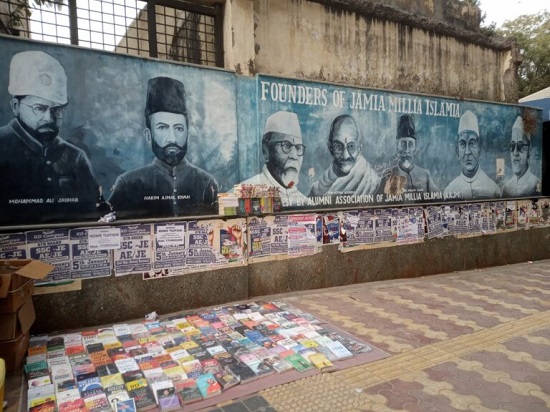
This project brings together memories relating to the founders and the subsequent builders of Jamia Millia Islamia, but also relating to the many who worked with them in less prominent positions, teachers, librarians, administrators, and staff. It works as a repository, guiding scholars and those interested in the history of the Jamia to the available sources, but it also aims at making available and generating new sources, through interviews and by encouraging people to put their memories to paper. The project is a common initiative by the Max Weber Forum and the Centre de Sciences Humaines CSH, both in Delhi.
Coordinators:
- Dr. Laurence Gautier, Centre de Sciences Humaines, Delhi (laurence.gautier@csh-delhi.com)
- Dr. Soheb Niazi, Max Weber Forum, Delhi (niazi@mwsindia.org)
- Prof. Dr. Margrit Pernau, Max Planck Institute for Human Development, Berlin (pernau@mpib-berlin.mpg.de)”
For more details, see https://mwfdelhi.hypotheses.org/retrieving-past-lives-from-jamia-tazkirah-e-jamia
Populations and spaces in transition
Head of the research area : Rama Devi
The research in this research area outlines a rapidly changing India, where contemporary transformations are reshaping the spatial and environmental structures of the country. The main drivers of these transition processes are primarily social and economic changes, but also include policy initiatives affecting urban localities, the natural environment and health outcomes. In particular, we focus on the outcomes of these dynamics on urban areas, the natural environment and demographic trends.
- Urbanization
We examine here some of the most salient challenges facing urban areas in India, ranging from emerging health issues, access to public goods, IT development and migration.
- Environment
We explore here the various ways in which the countryside responds to the recent development drives and the extent to which fragile natural spaces are impacted.
- Population, Family, Gender
We explore at both local and macro scales the deep transformations affecting the social and demographic fabric of Indian society, focusing notably on health, family and gender issues.
Researchers :
- CSH Members : Joël Cabalion, and David Singh
- CSH Associate Researchers: Christophe Z. Guilmoto, Bérénice Gérard, Hugo Ribadeau Dumas, Stéphanie Tawa Lama, Olivier Tell and Marie-Hélène Zerah.
- Visiting Researchers: Paras Arora, Gideon Mathson.
Project: Atlas of Gender and Health
Following a preliminary workshop at the CSH in 2020, a team of about 30 researchers directed by Christophe Z. Guilmoto and Nandita Saikia (IIPS, Mumbai) is working on an Atlas of gender and Health in India. This Atlas will bring together about 20 original chapters covering diverse issues ranging from demographic patterns (low fertility, migration, child mortality, etc.) to health behavior (anemia, hypertension, foodways, etc.), gender bias (son preference, girl-only families, women’s land ownership, etc.) and reproductive health (antenatal care, cancer screening, hospital deliveries, immunization, etc.).
The Atlas is based on the latest countrywide dataset that has been released in April 2022 and it will include about 30 district-level maps of gender and health indicators.

