
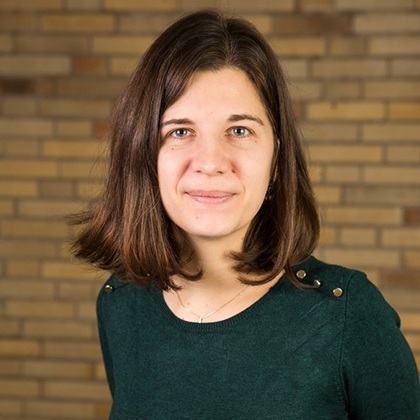
Camille BUAT
Researcher
Biography:
Camille Buat is a historian of modern South Asia, specialising in the social and political history of 20th century North India. She completed her PhD in 2022 from Sciences Po, Paris and the Centre for Modern Indian Studies, University of Göttingen. Before joining the CSH, Camille was a postdoctoral fellow at the Centre for Modern Indian Studies from 2022 to 2026, where she taught courses on the history of South Asia, labour history and social history.
Camille’s doctoral and postdoctoral research explored the intersection between labour, migration and citizenship in India. Through the reconstruction of the trajectory of “Hindustani” migrants from the states of UP and Bihar towards Calcutta, she explored the modalities of incorporation of “internal” migrants in the political and social landscape of late colonial and early postcolonial India. This research wove together a variety of sources, including government reports, life and family histories, and a corpus of Bhojpuri songs and plays dealing with the theme of migration.
Her new project aims to develop a social history of the postcolonial transition in rural India. It focuses more specifically on the period between the 1930s and 1960s as a moment of reconfiguration, as the political transformation associated with the advent of Independence intersected with long-term dynamics of social and economic change. The project is based on a detailed case study of the Bhojpuri region of eastern UP and western Bihar, and draws on a combination of judicial archives, literary sources and political material.
Camille is an associated researcher at the Centre for South Asian and Himalayan Studies (EHESS, Paris) and a member of the History Research Group at the Center for Modern Indian Studies, University of Göttingen. She serves on the editorial committee of the International Review of Social History.
Research interests:
- Labour history, history of migration
- History of citizenship and the postcolonial transition
- Rural history
Selected publications :
- Buat, Camille (forthcoming). “Rethinking the ‘rural link’: the political framing of labour in late colonial and postcolonial India”, in Ravi Ahuja (ed.), India’s Forces of Labour and the Limits of Democratization (c. 1930 to 1974): An Exploratory Compendium.
- Agarwal, Prerna, Camille Buat, Naveen Chander and Anna Sailer (eds.) (2025), Historiography on Labour History in South Asia, South Asia Chronicle, Vol. 15, 2025
- Buat, Camille (2024). “Vers une politique des nationalités. Le Parti communiste indien et la question régionale (années 1920-années 1950) », Parlement[s], no. 4, « Les gauches et l’international au XXe siècle”, pp. 37-56
- Buat, Camille (2020). “Segmented Possibilities: Migrant Life Histories of Hindustani Workers in Post-Colonial India”, International Labour and Working-Class History, vol. 97, pp. 134-158
- Buat, Camille (2018). “L’Inde coloniale en mouvement. Les régimes circulatoires des classes laborieuses en Asie du sud au XIXe siècle”, Revue d’histoire du XIXe siècle, vol. 56, no. 1, pp. 53-66